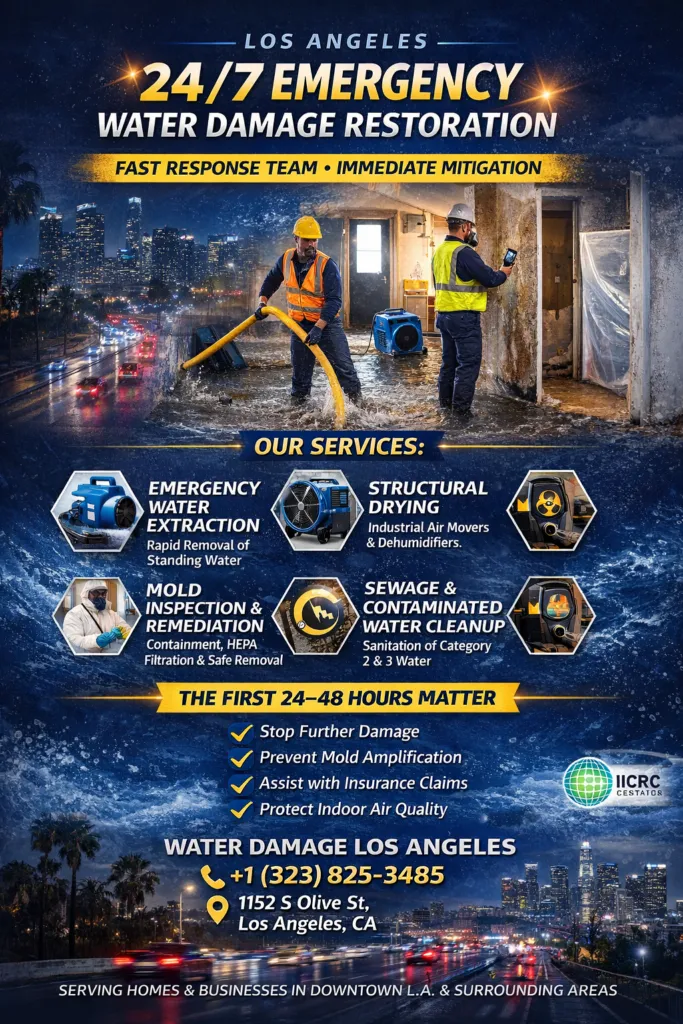
Water damage restoration in Los Angeles requires immediate action, technical precision, and compliance with industry drying standards. In dense urban environments like Downtown LA, water intrusion from burst pipes, slab leaks, roof failures, or appliance overflows can quickly escalate into structural deterioration and mold amplification within 24–48 hours.
Whether the issue affects a residential condo, commercial office, or multi-unit property, rapid mitigation reduces repair costs and protects indoor air quality. Professional restoration teams use commercial extraction systems, moisture mapping tools, and calibrated dehumidification equipment to return building materials to pre-loss condition safely.
Call Now – (323) 825-3485
Standing water must be removed before structural absorption spreads.
Emergency water extraction services in Los Angeles reduce secondary damage such as warped flooring, drywall swelling, and electrical risk.
After extraction, controlled drying prevents microbial growth and hidden moisture pockets.
Structural drying in Los Angeles properties typically ranges from 3–5 days depending on material saturation and humidity levels.
If moisture remains untreated, mold amplification can begin rapidly.
Sewage cleanup in Los Angeles requires Category 2 & 3 water sanitation protocols to eliminate bacteria and pathogens safely.
Water damage should be mitigated within the first 24 hours. Delays increase structural absorption and mold growth risk, leading to higher repair costs and extended restoration timelines.
Most policies cover sudden and accidental water damage (e.g., burst pipes). Gradual leaks or neglect may not qualify. Proper documentation from restoration professionals improves claim approval likelihood.
Typical drying takes 3–5 days. Severe saturation or high humidity may extend the process. Moisture readings determine completion—not visual dryness.
• Immediate response reduces total repair costs
• Professional drying prevents mold amplification
• Insurance documentation supports smoother claims
• Urban LA properties require fast dispatch capability
Water damage restoration in Los Angeles is a time-sensitive process that demands certified mitigation, precise drying, and thorough sanitation.
Water Damage Los Angeles
📞 (323) 825-3485
📍 1152 S Olive Street, Los Angeles, CA 90015
Serving Downtown Los Angeles and surrounding communities.
I’m dealing with a ceiling stain in my Downtown LA condo after my neighbor’s burst pipe. Since it’s been getting worse over the last day, what decision points should I watch for in that 24–48 hour window before it turns into a bigger problem?
In the first 24–48 hours, the key decision points are whether the water is still active, how far it’s spread beyond the visible stain, and whether drying has started fast enough. If the source isn’t fully stopped, you can keep getting hidden wetness in drywall and insulation. Another red flag is any musty odor or worsening discoloration, which can indicate the drying process hasn’t caught up and microbial growth risk is rising. A professional team will verify the full extent with moisture detection (often including thermal imaging) and then begin extraction and controlled drying with calibrated dehumidification and air movers to prevent secondary damage.
My insurer is saying a slab leak “just left staining,” but I’m worried there’s hidden moisture behind the drywall. How does moisture mapping actually show what needs to be repaired, and can it help if they dispute the scope?
Moisture mapping is meant to document moisture conditions beyond what’s visible. In practice, a restoration team will measure and record moisture readings across affected materials and use tools like thermal imaging to spot moisture pockets, wet drywall insulation, or saturation along the slab line. That creates an evidence trail showing where drying is required and why certain repairs are necessary (not just cosmetically addressing stains). If your claim is being questioned, the documented readings and mapped results can support the restoration scope so repairs align with actual moisture distribution.
After a dishwasher overflow in my kitchen, I’m worried about what’s “hidden” behind cabinets and baseboards. How do you confirm the drying is reaching everything that got wet, not just what I can see?
That’s a great concern. After the visible water is extracted, WDLA Water Damage Restoration L.A. typically uses moisture detection to take readings in affected materials (like drywall, subflooring, and framing) and compares them to unaffected areas. We also use thermal imaging to spot moisture patterns that aren’t obvious behind cabinets or under baseboards. Drying equipment is then positioned to target the specific areas with elevated readings, and we continue monitoring until moisture levels return to a normal, pre-loss range. This helps ensure the job addresses hidden saturation, not just surface dampness.